Google Block Breaker Blocks: Every Block Type, What They Do & How to Target Them (2026)
Most Google Block Breaker guides describe blocks that do not actually exist in the game.
Bomb blocks. Rainbow blocks. Mystery blocks. Lock and key systems. None of these are in Google Block Breaker. They come from other brick-breaking games entirely, and guides that include them are giving you wrong information that will not help your gameplay at all.
This guide covers only what is actually in the game — every real block type in Google Block Breaker, what each one does, how points work, and exactly how to prioritize your targets for the highest possible score.
What Are Google Block Breaker Blocks?
Google Block Breaker blocks are the colored rectangular targets that fill the top portion of the playing field at the start of each level. Your goal is to destroy all breakable blocks using the ball and paddle. Clear every breakable block and the level ends.
Blocks differ in two key ways: how many hits they take to destroy, and how many points they give when destroyed. Understanding both determines your entire targeting strategy.
The block system in Google Block Breaker is deliberately straightforward compared to other brick-breaking games. There are no puzzle mechanics, no chain reactions, and no random effects. Every block behaves predictably — which means every targeting decision you make has a clear, knowable outcome.
Google Block Breaker Block Types — The Complete List
There are four distinct block categories in Google Block Breaker. Here is every one explained fully.
Standard Colored Blocks
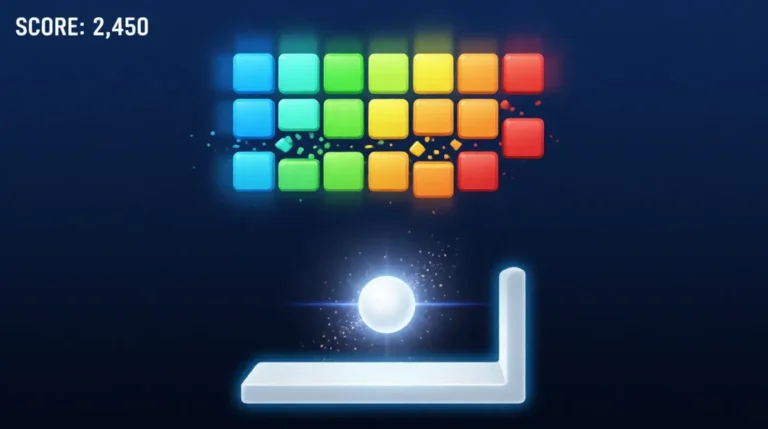
Standard colored blocks make up the majority of every level. They break in a single hit and award points based on their color. The color indicates both the block’s row position and its point value — higher rows contain higher-value colors.
These are your primary targets throughout every level. They are plentiful, predictable, and form the foundation of your scoring.
Point values by color:
| Block Color | Points Per Hit | Hits to Destroy |
|---|---|---|
| Blue | 10 points | 1 |
| Green | 20 points | 1 |
| Yellow | 30 points | 1 |
| Orange | 40 points | 1 |
| Red | 50 points | 1 |
Red blocks in the upper rows are your highest single-hit value targets among standard blocks. Clearing a path to them early — while the ball is still slow and controllable — is the correct opening strategy in every level.
Targeting strategy: Do not sweep through blue blocks at the bottom first. Work upward. Every ball that hits a red block instead of a blue block is worth five times as many points. At a 5x combo multiplier, a red block gives 250 points versus a blue block’s 50.
Silver Blocks
Silver blocks are the first multi-hit block type in Google Block Breaker. They require two hits to destroy. On the first hit, the block visually cracks or changes appearance to indicate it has been damaged. The second hit destroys it completely and awards the full point value.
Silver blocks give 100 points when fully destroyed — double the value of a red block and ten times a blue block.
They appear less frequently than standard colored blocks and tend to be positioned in more protected areas of the level layout, often requiring deliberate angle management to reach consistently.
Targeting strategy: Silver blocks are worth the extra hit. The 100-point value at full combo multiplier gives 500 points per block — making them among the highest-priority targets on any board. Clear a path to silver blocks early. Use edge hits on your paddle to create the angles needed to reach them in protected positions.
Important: Two hits means two combo count increments. Each hit on a silver block counts toward your consecutive hit streak, helping maintain your multiplier while you work toward the second hit.
Gold Blocks
Gold blocks are the highest-value block type in Google Block Breaker. They require three hits to destroy and award 200 points upon full destruction. Like silver blocks, each hit visually damages the block — you can see its condition change across three stages.
At a 5x combo multiplier, a single gold block gives 1,000 points. This is the highest point value achievable from a single block in the game.
Gold blocks appear rarely in each level and are almost always positioned in the most difficult-to-reach areas — upper corners, behind indestructible block barriers, or in locations that require precisely angled shots.
Targeting strategy: Gold blocks deserve dedicated shot planning. Before going for a gold block, make sure your combo multiplier is already at 5x — the point difference between hitting it at 1x versus 5x is 800 points from a single block. Use the sticky paddle power-up when available to set up the precise angle a protected gold block requires. Three hits to destroy means three combo increments, making gold blocks excellent for building and maintaining streak multipliers.
Indestructible Blocks
Indestructible blocks — typically gray or distinctly patterned to differentiate them from colored blocks — cannot be destroyed regardless of how many times the ball hits them. No power-up, no angle, no number of hits will break them.
They are permanent fixtures of the level layout. The ball bounces off them exactly as it bounces off walls and the ceiling.
Indestructible blocks serve as strategic obstacles that force specific ball trajectories. They protect certain areas of the board, create angles that are impossible to use directly, and require you to plan around their position rather than through it.
Targeting strategy: Accept indestructible blocks as fixed elements and use them. The ball will bounce off an indestructible block predictably — which means you can use them as deliberate deflection points to reach other blocks at angles your paddle alone cannot create. Treat them like extra walls. A ball that bounces off an indestructible block into a cluster of gold or silver blocks behind it is a successful shot.
Important: You do not need to destroy indestructible blocks to complete a level. Only breakable blocks count toward level completion. Focus entirely on the blocks that can be destroyed.
Power-Up Releasing Blocks
Certain blocks in Google Block Breaker release a power-up when destroyed. These blocks look identical to standard colored blocks — you cannot visually identify them before hitting them. The power-up reveal only happens upon destruction.
When a power-up block is destroyed, the block disappears normally and a power-up icon begins falling downward from the block’s position toward your paddle. You must catch the falling icon to activate it.
Power-up blocks award the same points as any other block of their color. The power-up is a bonus on top of the standard point value, not a replacement.
Which blocks release power-ups: The distribution is partially randomized per session, but certain block positions in specific levels have higher drop rates. Golden-colored blocks — the actual gold blocks requiring three hits — have notably higher power-up drop rates than standard colored blocks. Prioritizing these blocks gives you more power-up opportunities.
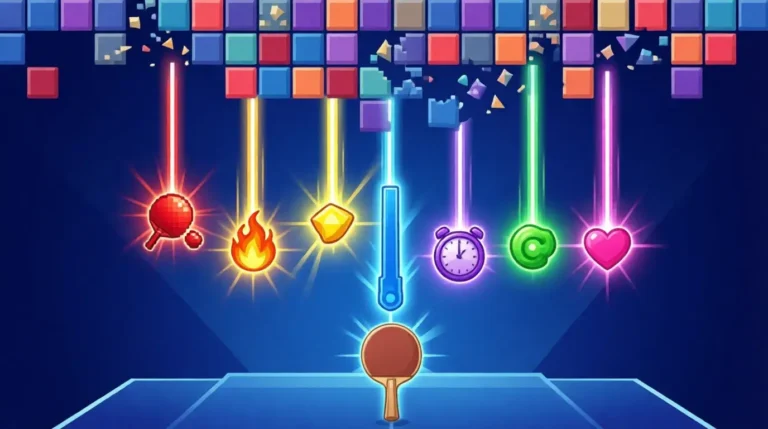
Targeting strategy: Since you cannot identify power-up blocks visually in advance, focus on targeting high-value blocks for their point value. Power-ups will appear as a natural result of gameplay. The one exception is during a power-up drought — if you have gone several levels without a heart appearing, prioritizing gold block destruction increases your chance of triggering one. For complete information on every power-up and how to use them, see our Google Block Breaker power-ups guide.
Google Block Breaker All Blocks — Point Values and Priority
Now that every block type is clear, here is exactly how to prioritize them during gameplay.
Complete Block Reference
| Block Type | Points | Hits Required | Priority |
|---|---|---|---|
| Gold | 200 | 3 | 🔴 Highest |
| Silver | 100 | 2 | 🟠 High |
| Red | 50 | 1 | 🟡 Medium-High |
| Orange | 40 | 1 | 🟡 Medium |
| Yellow | 30 | 1 | 🟢 Medium-Low |
| Green | 20 | 1 | 🟢 Low |
| Blue | 10 | 1 | ⚪ Lowest |
| Indestructible | 0 | Cannot destroy | Navigate around |
Targeting Priority Explained
Target gold blocks first — 200 points at 5x multiplier is 1,000 points per block. Three hits each means three combo increments per block. Gold blocks earn their targeting priority on both metrics.
Target silver blocks second — 100 points, two hits, accessible earlier in the game than most gold blocks. Clearing silver blocks early while the ball is slower gives you better control over the two-hit process.
Target red blocks third — 50 points per single hit. In the upper rows, these are your fastest high-value scoring opportunity. Clearing upper red rows also sets up the trap shot by creating gaps near the ceiling.
Clear standard blocks strategically — do not sweep random standard blocks. Clear them in a pattern that opens access to higher-value targets above and creates the vertical gap needed for trap shot execution.
Use indestructible blocks as tools — plan your ball trajectory to bounce off them into block clusters rather than treating them purely as obstacles.
Google Block Breaker Block Types — How Speed Affects Strategy
As you clear blocks, the ball speed increases automatically. This changes how you should approach block targeting at different stages of the level.
At 0 to 30% cleared, the ball moves at base speed. This is your opportunity to deliberately target gold and silver blocks that require multiple hits — you have the reaction time to set up precise angles.
At 30 to 60% cleared, speed begins increasing. Continue prioritizing high-value blocks but shift toward more conservative paddle positioning. Do not attempt difficult angle shots that risk the ball at this stage.
At 60 to 80% cleared, significant speed increase. The remaining blocks are typically scattered — some in protected corners, some indestructible blocks creating deflection challenges. Use the laser paddle power-up here if available to target remaining awkward blocks directly.
At 80 to 100% cleared, maximum speed. The final few blocks are the hardest in the level. The ball is moving at peak velocity, there are fewer blocks deflecting it back toward your paddle, and each miss is more costly. Play conservatively. Protect your combo. Use the sticky paddle if available to control each shot.
Understanding this speed progression changes how you approach block targeting. Rush high-value blocks when the game is slow. Play safe and deliberate when it is fast. For complete guidance on managing ball speed across all levels, see our how to play Google Block Breaker guide.
Google Block Breaker Special Blocks — What Actually Qualifies
The term “special blocks” in Google Block Breaker accurately describes silver and gold blocks — the multi-hit blocks that behave differently from standard colored blocks and offer significantly higher point values.
Some guides describe elaborate special block systems with explosions, chain reactions, and puzzle mechanics. These do not exist in Google Block Breaker. The game’s design is intentionally clean and physics-based — your skill with the paddle and ball determines outcomes, not random block effects.
This simplicity is a feature. Because blocks behave predictably, every targeting decision you make has a knowable result. There are no surprise mechanics. No block will unexpectedly change the rules. This makes Google Block Breaker a pure skill game — practice and understanding translate directly into better scores.
Google Block Breaker Symbols Meaning
The visual information Google Block Breaker communicates through block appearance is straightforward:
Color indicates point value and hit count. Standard colored blocks follow the blue-to-red spectrum from lowest to highest value. Silver and gold blocks have distinct metallic appearances that visually separate them from the color spectrum.
Visual damage state on silver and gold blocks shows how many hits remain. A visibly cracked or damaged block is one hit away from destruction. This lets you track multi-hit blocks across multiple ball contacts without losing count.
Gray or patterned appearance on indestructible blocks immediately communicates that the block cannot be destroyed. This visual distinction is clear enough to identify in fast gameplay.
That is the complete symbol system in Google Block Breaker. There are no numbers on blocks, no arrow indicators, no lock icons, and no mystery question marks. The game communicates everything you need to know through color and visual damage state alone.
Google Block Breaker Blocks — Stats That Matter
Understanding block distribution across a typical level reveals why targeting strategy matters so much.
A standard Google Block Breaker level contains approximately:
- 60 to 70% standard colored blocks — the bulk of the board
- 15 to 20% red blocks — highest single-hit value
- 8 to 12% silver blocks — multi-hit, high value
- 3 to 5% gold blocks — multi-hit, highest value
- 5 to 10% indestructible blocks — varies significantly by level
Gold and silver blocks together represent roughly 15% of blocks but account for a disproportionate share of scoring potential. A player who consistently targets these blocks at 5x multiplier will outscore a player who clears the board randomly by thousands of points — even if both players complete the same number of levels.
This is why block knowledge translates directly into score improvement. It is not about playing faster or reacting quicker. It is about knowing which 15% of the board to prioritize.
Frequently Asked Questions
What are all the blocks in Google Block Breaker? Google Block Breaker has five block types: standard colored blocks (blue, green, yellow, orange, red), silver blocks requiring two hits, gold blocks requiring three hits, indestructible gray blocks that cannot be destroyed, and power-up releasing blocks that drop items when destroyed.
What do all the blocks do in Google Block Breaker? Standard colored blocks break in one hit and give 10 to 50 points depending on color. Silver blocks take two hits and give 100 points. Gold blocks take three hits and give 200 points. Indestructible blocks cannot be destroyed and act as permanent obstacles. Certain blocks release power-ups when destroyed.
What are Google Block Breaker special blocks? In Google Block Breaker, the special blocks are silver and gold — both require multiple hits and give significantly higher points than standard colored blocks. Silver gives 100 points over two hits. Gold gives 200 points over three hits. These are the highest-priority targets in every level.
What do Google Block Breaker symbols mean? Block color indicates point value — blue is lowest at 10 points, red is highest standard block at 50 points. Silver and gold appearances indicate multi-hit blocks. Visual damage state on silver and gold blocks shows remaining hits. Gray or patterned blocks are indestructible. There are no number symbols, arrows, or mystery indicators in the actual game.
Which Google Block Breaker blocks should I target first? Target gold blocks first for 200 points each, then silver blocks for 100 points each, then red blocks for 50 points each. Work from highest value to lowest. Always build your combo multiplier to 5x before hitting gold blocks — a gold block at 5x multiplier gives 1,000 points versus 200 at 1x.
Can all Google Block Breaker blocks be destroyed? No. Indestructible blocks — typically gray — cannot be destroyed regardless of hits. All other block types can be destroyed: standard colored blocks in one hit, silver in two hits, and gold in three hits. You only need to destroy breakable blocks to complete a level.
What is the highest-value block in Google Block Breaker? Gold blocks give 200 points per destruction and require three hits. At maximum 5x combo multiplier, a single gold block gives 1,000 points. They are the highest-value individual target in the game and should be the primary focus of every targeting strategy.
Final Thoughts
Google Block Breaker’s block system is simpler than most guides suggest — and that simplicity is the point. Five block types, clear visual communication, predictable physics. No hidden mechanics, no random effects, no puzzle sequences.
What makes the difference between a 5,000-point run and a 50,000-point run is not discovering secret block types. It is knowing that gold blocks at 5x multiplier give 1,000 points each, that silver blocks are worth the extra hit, that indestructible blocks are tools rather than obstacles, and that targeting priority — gold first, silver second, red third — should govern every shot decision.
Apply that knowledge consistently and your scores will reflect it.
Ready to test your block knowledge in a real session? Play Google Block Breaker on the homepage now.