Google Block Breaker Power Ups: Complete List, Effects & Strategy Guide (2026)
Power-ups are the difference between a 5,000-point run and a 50,000-point run in Google Block Breaker.
Most players catch whatever falls toward their paddle without thinking. They grab multi-balls at the worst possible moment, miss hearts completely, and wonder why their scores plateau. The mechanics are not complicated — but they are specific, and getting them wrong costs far more than most players realize.
This guide covers every power-up in Google Block Breaker, what each one actually does, when to use them, when to avoid them, and which combinations produce the biggest scores. No guessing. No generic advice. Just the complete breakdown.
What Are Google Block Breaker Power Ups?
Power-ups are special items that drop from certain blocks when they are destroyed. They fall downward from the block’s position toward your paddle. If your paddle catches them, they activate immediately. If they fall past your paddle, they disappear — missed opportunity.
Each power-up has a distinct icon and color so you can identify it during fast-paced gameplay without stopping to think. Some appear frequently. Others — especially the heart — are rare and need to be prioritized the moment they appear.
Power-ups in Google Block Breaker are entirely beneficial. Unlike some classic brick-breaking games that include negative power-ups designed to punish players, every item in Google’s version helps you in some way. The strategic question is never “is this good?” — it is always “is this good right now, and is catching it worth the risk?”
Google Block Breaker Power Ups — Complete List
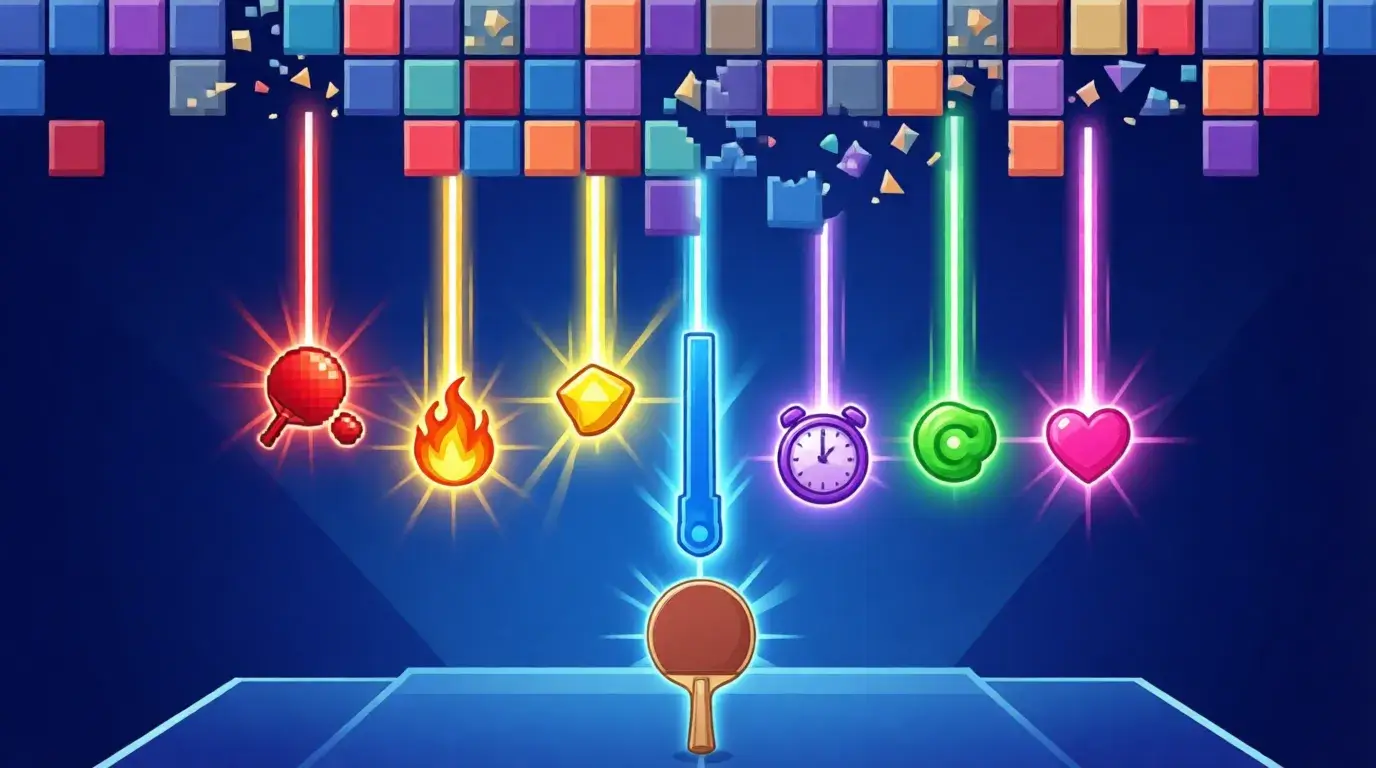
Google Block Breaker features seven core power-ups. Here is every one, explained fully.
Multi-Ball
Multi-ball splits your current ball into three separate balls simultaneously. Each ball behaves independently — bouncing off walls, blocks, and your paddle as a separate object. Every ball destroys blocks and contributes to your score.
The scoring implications are significant. Three balls hitting blocks in the same timeframe triples your point accumulation rate. During a 5x combo multiplier, multi-ball running for even 10 to 15 seconds can add thousands of points.
The risk is real: if all three balls fall past your paddle at the same moment, you lose a life. Managing multiple balls requires full attention. Do not grab multi-ball when you are distracted or when ball speed has already reached a level where tracking one ball is difficult.
Best use: Dense block sections in early-to-mid levels where blocks are plentiful and ball speed is manageable.
Avoid when: Ball speed is already high, you are on your last life, or you are in the middle of a carefully managed trap shot setup.
Fireball
Fireball temporarily transforms your ball into a burning projectile that passes through blocks without bouncing. Instead of ricocheting off each block individually, the ball cuts directly through entire columns or clusters, destroying everything in its path in one pass.
This is the fastest block-clearing power-up in the game. A fireball aimed at a dense upper section can clear five to eight blocks in a single trajectory — blocks that would have taken multiple careful bounces to reach otherwise.
The effect lasts approximately 10 to 15 seconds. Use it aggressively immediately after activation — every second the fireball is active is a scoring opportunity.
Best use: Clearing vertical columns to set up a trap shot, or destroying hard-to-reach upper clusters that normal ball physics cannot reach efficiently.
Avoid when: Only a few blocks remain and precise targeting matters more than raw clearing power.
Laser Paddle
Laser paddle equips your paddle with the ability to shoot laser beams upward. Click or tap to fire. Each laser travels vertically and destroys one block on contact. You typically get around 10 shots or 20 seconds of duration — whichever ends first.
This is the precision power-up. Where multi-ball creates chaos and fireball bulldozes through clusters, laser paddle lets you surgically target specific blocks — the stubborn corner block, the last gold block keeping a level from ending, the block hiding behind an indestructible barrier.
Best use: End-of-level cleanup when only a few awkwardly positioned blocks remain. Also effective for targeting high-value gold and silver blocks that are difficult to reach with normal ball angles.
Avoid when: You have a fast-moving ball that needs constant attention — firing lasers while tracking the ball splits your focus dangerously.
Expand Paddle
Expand paddle increases your paddle’s width by approximately 50% for around 30 seconds. The wider surface makes catching the ball significantly easier, reduces the need for precise positioning, and gives you more room to deliberately choose where on the paddle the ball makes contact.
For beginners, this is a lifesaver. For advanced players, it is a comfort tool — useful in specific situations but not something to rely on as a primary strategy.
One important tradeoff: a wider paddle makes sharp-angle edge shots harder to execute. If your strategy depends on steering the ball with precise paddle-edge contact, the expanded paddle can actually work against you by making edge hits less consistent.
Best use: When ball speed has increased significantly in later levels and keeping the ball alive is genuinely difficult. Also useful during multi-ball sequences where covering more ground helps.
Avoid when: You need precision angle control more than coverage — particularly during trap shot setups.
Slow Ball
Slow ball reduces the ball’s speed to approximately 60% of its current velocity for around 20 seconds. Everything about the game becomes more manageable — you have time to read trajectories, plan your next shot angle, and position your paddle deliberately rather than reactively.
This power-up is underrated. Players dismiss it as a “beginner” tool, but it has real strategic value at any skill level. In later levels where speed has escalated significantly, a 20-second slow ball window can be the difference between maintaining a combo streak and losing it.
Best use: Any moment when you feel control slipping — ball speed is making reactions difficult, multiple near-misses are happening, or you need time to execute a specific setup.
Avoid when: Ball speed is comfortable and you are already in a clean scoring rhythm — slowing the ball down unnecessarily can actually disrupt timing you have already adapted to.
Sticky Paddle
Sticky paddle temporarily causes the ball to stop and stick to your paddle on contact instead of bouncing immediately. The ball stays attached until you click or tap to release it, giving you full control over launch timing and angle.
This is the most strategic power-up in the game. While every other power-up provides a direct mechanical advantage, sticky paddle provides a planning advantage. You choose exactly when to release the ball and at what angle. You can aim for a specific block cluster, set up the trajectory for a trap shot, or take a moment to assess the board before committing to the next shot.
The duration is measured in catches — typically five catches before the effect expires.
Best use: When precision matters more than speed. Setting up a trap shot, targeting the last few difficult blocks, or any moment where a controlled deliberate shot beats a reactive one.
Avoid when: You are in a multi-ball sequence — sticky paddle only catches one ball, leaving the others bouncing freely and creating a confusing split-attention situation.
Heart (Extra Life)
The heart is the most valuable power-up in Google Block Breaker. It grants one additional life immediately upon collection, increasing your life counter by one. This directly extends how long your run can continue.
Hearts appear rarely — roughly once every three to four levels under normal conditions. They can spawn more frequently when breaking special or golden blocks, which have higher power-up drop rates. When a heart appears, it takes absolute priority over every other power-up or game action.
What does the heart do in Google Block Breaker beyond the obvious? It changes your risk tolerance for the entire remainder of the session. An extra life means you can attempt a riskier angle shot, chase a difficult block cluster, or take an aggressive trap shot setup that you might otherwise avoid. The value is not just the life itself — it is the strategic freedom the extra life provides.
Best use: Always catch hearts. No exception. No situation exists where ignoring a heart is the correct decision.
Note on maximum lives: Most versions of the game cap lives at five. If you are already at maximum, a heart is still worth catching — it resets your buffer to maximum if you have taken any losses since last reaching the cap.
For a full breakdown of how lives affect scoring strategy, see our Google Block Breaker rules guide.
Google Block Breaker Power Ups — Stats and Impact
The numbers behind power-up usage reveal why strategic collection matters so much.
Community data and player reports from high-score runs show consistent patterns across google block breaker powerups usage:
- Players who prioritize hearts over offensive power-ups report 40 to 60% longer average session lengths than those who chase multi-balls first
- A successful multi-ball activation during a 5x combo multiplier can generate 3,000 to 8,000 points in a single 15-second window — more than many players score in an entire early-game session
- Fireball combined with a trap shot setup clears the board 3 to 4 times faster than standard ball physics alone
- The sticky paddle — the most underused power-up — enables trap shot setups that community high-score holders cite as the single biggest contributor to scores above 50,000 points
These are not marginal differences. Power-up strategy is one of the highest-leverage areas of improvement available to any player regardless of current skill level.
Power Up Priority — When to Catch, When to Let Fall
Understanding google block breaker power ups explained properly means knowing that catching everything is not always correct. Here is how to think about each situation.
Always Catch
Heart — no exceptions, regardless of what else is happening on screen.
Multi-ball — almost always, unless ball speed is already unmanageable or you are on your last life with a fragile combo.
Catch Based on Situation
Expand paddle — catch when ball speed is high or when you are struggling to maintain control. Let it fall if you need precise angle shots and the ball is manageable.
Laser paddle — catch when you can spare attention from the ball. Avoid when the ball requires constant tracking.
Fireball — catch almost always. The window is short and the clearing potential is high.
Slow ball — catch when speed has escalated. Less useful when speed is already comfortable.
Catch Carefully
Sticky paddle — excellent power-up, but catching it during multi-ball creates problems. If multi-ball is active, let sticky paddle fall rather than creating a confused split-attention situation.
Google Block Breaker All Power Ups — Best Combinations
Certain google block breaker items work dramatically better together than individually. These are the combinations that high-score players use deliberately.
Multi-Ball + Expand Paddle
The expand paddle covers the wider area that three separate balls demand. You maintain control over all balls simultaneously without the frantic repositioning that multi-ball normally requires. Points accumulate at triple the normal rate while the expanded paddle makes it manageable.
This is the most reliable combination for sustained high scoring.
Slow Ball + Laser Paddle
Reduced ball speed gives you the time to aim and fire lasers deliberately without splitting attention between ball tracking and targeting. You clear blocks with precision while maintaining complete control of the ball’s position. Surgical and effective.
Fireball + Multi-Ball
Three balls, all passing through blocks without bouncing. This is maximum chaos in the most productive sense — the entire board clears in seconds. The points generated in a 15-second fireball plus multi-ball overlap can represent a significant portion of a high-scoring session’s total.
The risk is real: three fireballs moving simultaneously are genuinely difficult to track. Have the expand paddle active if possible before triggering this combination.
Sticky Paddle + Any Setup
Sticky paddle makes every other power-up more effective by giving you a pause to plan. After catching any power-up, if sticky paddle is also active, you have a moment to assess the board and decide exactly where to direct the ball for maximum impact.
Google Brick Breaker Power Ups — Common Mistakes
These are the errors that cost players points and lives regularly.
Chasing power-ups recklessly. Moving the paddle aggressively to catch a falling item and missing the ball as a result is the most common mistake. The ball always takes priority. A power-up you miss costs nothing. A ball you miss costs a life and resets your combo.
Ignoring hearts. Some players are so focused on scoring power-ups that a heart falls past unnoticed. Given how rarely they appear, missing a heart is one of the most costly errors possible.
Using sticky paddle during multi-ball. The two power-ups conflict directly. Sticky paddle catches one ball and freezes it, leaving the others bouncing freely. Your attention is now split between the stationary ball (when to release it) and the moving ones (keeping them alive). The result is usually a missed ball.
Grabbing speed boost when already fast. Speed boost increases ball velocity — which in later levels where speed has already escalated significantly, can make the game genuinely uncontrollable. This is the only power-up where letting it fall is frequently the right call.
Frequently Asked Questions
What are all the Google Block Breaker power ups? Google Block Breaker has seven core power-ups: multi-ball, fireball, laser paddle, expand paddle, slow ball, sticky paddle, and heart. Each drops from destroyed blocks and activates when caught by your paddle.
What does the heart do in Google Block Breaker? The heart grants one extra life immediately. Your life counter increases by one, allowing you to survive one additional ball drop before game over. Hearts are rare — appearing roughly every three to four levels — and should always be caught before any other power-up.
What is the best Google Block Breaker power up? For offensive scoring, multi-ball generates the most points in the shortest time. For overall game value, the heart is most important because it extends your run directly. For strategic control, sticky paddle enables setups that no other power-up can match.
What is the Google Block Breaker power ups list in order of priority? Priority order: heart first, then multi-ball, expand paddle, fireball, laser paddle, slow ball, and sticky paddle — with sticky paddle being situational rather than universally low priority.
Do Google Block Breaker power ups stack? Many stack effectively. Multi-ball works alongside all paddle modifications. Fireball combines with multi-ball for maximum clearing. Expand paddle and laser paddle stack cleanly. Some override rather than stack — consecutive expand paddle catches reset the duration rather than doubling the width.
How do you get more hearts in Google Block Breaker? Hearts drop from special and golden blocks at higher rates than standard blocks. Prioritizing these blocks during gameplay increases heart frequency. You cannot force hearts to appear, but targeting high-value blocks gives you the best chance.
What do the Google Block Breaker items actually look like? Each power-up has a distinct icon — multi-ball shows multiple circles, fireball shows a flame, laser paddle shows a beam, expand paddle shows a wide rectangle, slow ball shows a clock, sticky paddle shows an adhesive symbol, and the heart shows a pink heart. Identifying them quickly during gameplay is a skill that develops with practice.
Final Thoughts
Google Block Breaker power-ups reward players who think before they catch. The difference between grabbing every falling item reflexively and making deliberate collection decisions represents thousands of points per session.
Start with one change: always catch hearts, no matter what. From there, build the habit of evaluating each power-up before moving your paddle — is catching this worth the risk right now? That single mental check, applied consistently, will improve your scores faster than any other adjustment.
Ready to practice? Play Google Block Breaker on the homepage and run through a full session focused purely on power-up decision-making.