How Long Is 300 Feet? Visual Guide, Comparisons & Real-World Examples
300 feet is one of those distances that sounds significant but is hard to picture without a reference point. It is longer than most people realize when they are standing at one end trying to imagine the other, and shorter than most people expect when they see it on a map.
This guide makes 300 feet concrete. Exact conversions, real-world visual comparisons, sports field references, and a practical sense of how long 300 feet takes to walk or drive, all in one place.
How Long Is 300 Feet Exactly?
300 feet is a unit of distance from the imperial measurement system. Here are the exact conversions:
- 300 feet in meters: 91.44 meters
- 300 feet in yards: 100 yards (exactly)
- 300 feet in miles: 0.0568 miles (just over one-eighteenth of a mile)
- 300 feet in kilometers: 0.09144 kilometers
- 300 feet in inches: 3,600 inches
- 300 feet in cm: 9,144 centimeters
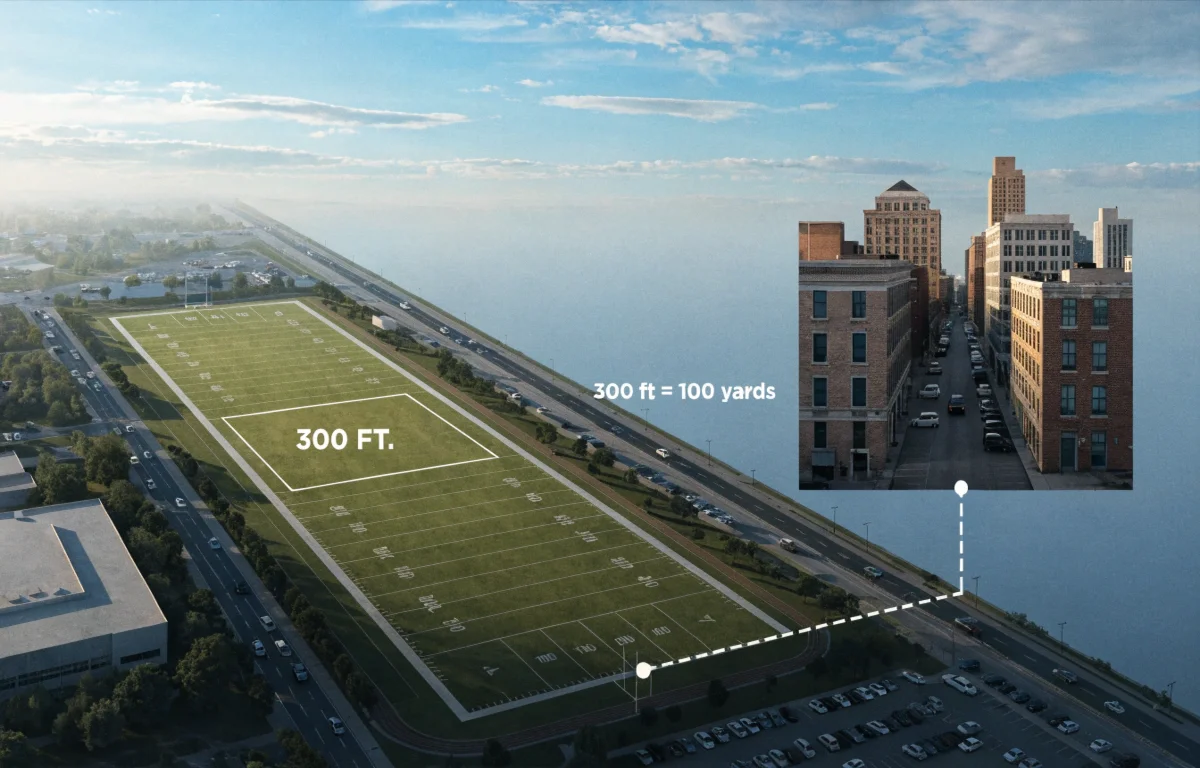
The cleanest relationship to remember: 300 feet is exactly 100 yards. One hundred yards is the length of an American football field from end zone to end zone, which makes 300 feet one of the most recognizable distances in American sports and culture.
How Long Is 300 Feet Visually: Real-World Comparisons
The best way to understand 300 feet is to place it next to things people already know. The comparisons below are based on verified or standardized sizes.
One American Football Field (End Zone to End Zone)
An NFL football field measures exactly 100 yards from end zone to end zone, which is exactly 300 feet. This is the single most precise and recognizable reference for this distance. If you have ever stood at one end of a football field and looked toward the opposite end zone, you have seen exactly 300 feet in front of you.
The playing field itself (excluding the end zones) is 100 yards. Adding the two 10-yard end zones brings the full field to 120 yards, but the 100-yard playing surface between the goal lines is exactly 300 feet.
Statue of Liberty (Base to Torch)
The Statue of Liberty stands approximately 305 feet from the base of the pedestal to the top of the torch. This makes it almost exactly 300 feet tall. Picturing the Statue of Liberty gives an excellent vertical reference for this height.
A 25 to 30 Story Building
The average floor height in a commercial building is approximately 10 to 12 feet per floor. A building with 25 to 30 floors therefore reaches approximately 250 to 300 feet in height. Many downtown office buildings in mid-sized American cities fall in this height range.
Boeing 747 Airplane Wingspan
The wingspan of a Boeing 747-400 is approximately 213 feet. A 300-foot distance extends about 87 feet past one full 747 wingspan, which is roughly equivalent to adding a third of another wingspan. Picturing a large commercial airplane on a runway gives a strong sense of the scale of 300 feet.
One City Block (Most American Cities)
City block lengths vary by city, but in most American cities a standard block measures between 250 and 330 feet. In cities like Chicago, a standard block is approximately 330 feet. In New York City, east-west blocks along numbered streets average around 250 feet. 300 feet falls squarely in the middle of a typical American city block, making it one of the most practical everyday references for this distance.
Why this works: Most people have walked a full city block. 300 feet is that exact familiar experience, no calculation needed.
Two NHL Hockey Rinks
A standard NHL hockey rink measures 200 feet in length. One and a half hockey rinks placed end to end equals exactly 300 feet. Picturing a full hockey rink and then extending it by half that distance again gives a clear linear reference.
Three Blue Whales in a Line
A blue whale, the largest animal on Earth, measures approximately 80 to 100 feet in length. Three blue whales placed nose to tail measure between 240 and 300 feet. At the upper end of blue whale size, three of them in a line equals exactly 300 feet.
The Height of Niagara Falls
The Horseshoe Falls section of Niagara Falls drops approximately 188 feet, while the American Falls section drops approximately 70 to 110 feet. A full 300 feet is notably taller than either section of Niagara Falls, giving a strong vertical reference point. The combined visual scale of Niagara Falls is a useful anchor when imagining 300 vertical feet.
How Long Is 300 Feet in Sports
Sports provide some of the most precise and standardized references for 300 feet because athletic fields and courts are built to exact regulated dimensions.
American Football
300 feet is exactly the length of an NFL football field from goal line to goal line. The 100-yard measurement converts directly to 300 feet. This is the single most accurate and widely recognized sports reference for this distance.
Baseball
In Major League Baseball, outfield fence distances vary by stadium, but 300 feet is a significant benchmark:
- The minimum distance from home plate to the nearest outfield fence is 325 feet in fair territory under MLB guidelines
- 300 feet from home plate falls just inside the outfield for most stadiums
- A batted ball traveling 300 feet in the air is approaching home run territory, depending on the stadium
Soccer
A full-size FIFA regulation soccer pitch is between 100 and 110 meters long (approximately 328 to 360 feet). 300 feet (91.44 meters) falls just short of the minimum regulation length for a soccer pitch. Picturing a regulation soccer field gives a very close approximation of 300 feet in length.
Basketball
An NBA basketball court measures 94 feet in length and 50 feet in width. 300 feet is slightly more than three full NBA courts placed end to end (3 x 94 = 282 feet). Picturing three basketball courts lined up in sequence gives a slightly short but useful reference for 300 feet.
Swimming Pool
An Olympic swimming pool is 50 meters long, which equals approximately 164 feet. 300 feet is almost exactly equivalent to two Olympic swimming pools placed end to end (2 x 164 = 328 feet). One and three-quarter Olympic pools gives a close approximation.
Track and Field
A standard outdoor track has a perimeter of 400 meters (approximately 1,312 feet). 300 feet represents just under one-quarter of a full track lap. Watching a sprint race and imagining the first quarter of the track gives a practical sense of 300 feet.
How Long Is 300 Feet to Walk or Drive
Understanding 300 feet in terms of travel time makes the distance practical and relatable for everyday situations.
Walking 300 Feet
The average adult walking speed is approximately 3 to 4 miles per hour, which translates to roughly 4 to 5 feet per second.
At average walking speed, 300 feet takes approximately:
- 60 to 75 seconds at a comfortable pace
- 45 to 55 seconds at a brisk walking pace
- Just over 1 minute for most people under normal conditions
For practical reference, walking 300 feet is roughly equivalent to:
- Walking from one end of a football field to the other
- Crossing approximately one to two city blocks depending on the city
- The distance covered during a short walk from a parking spot to a building entrance in a large parking lot
Driving 300 Feet
At standard driving speeds, 300 feet passes very quickly:
- At 25 mph (typical residential or parking lot speed): approximately 8 seconds
- At 35 mph (typical urban road speed): approximately 6 seconds
- At 55 mph (typical highway speed): approximately 4 seconds
- At 65 mph (typical freeway speed): approximately 3 seconds
For practical reference, driving 300 feet at highway speed takes less time than most people spend deciding which radio station to put on.
300 Feet as a Safety or Legal Distance
300 feet appears frequently in legal and safety contexts as a required distance:
- Many local ordinances require motorists to maintain 300 feet of following distance from emergency vehicles with lights on
- Some noise ordinances apply to sounds audible at 300 feet from the source
- Fireworks regulations in many jurisdictions require that they be set off at least 300 feet from occupied structures
- Some zoning laws require certain businesses to be located at least 300 feet from schools or churches
FAQ
Conclusion
300 feet is exactly 100 yards, one football field, and just over 91 meters. Once that football field image is locked in, 300 feet becomes easy to recognize and estimate in any situation.
Whether you are trying to picture a building height, understand a legal distance requirement, estimate how far you need to walk, or simply make sense of a measurement you encountered in a product description or map, 300 feet is one of the most approachable large distances to visualize once you connect it to a football field.