Jerry Lawson: The Man Who Invented the Game Cartridge — Google Doodle Game Guide (2026)
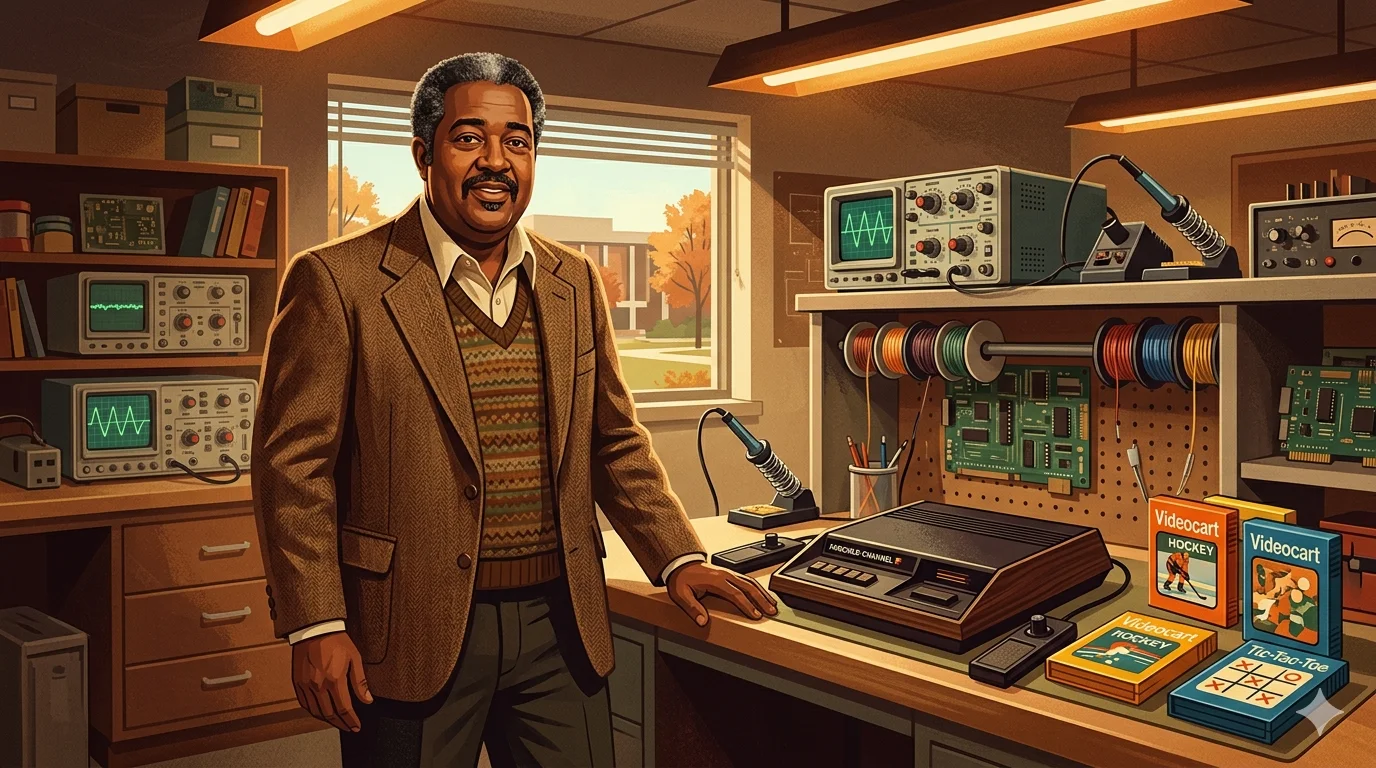
Here’s a name most people don’t know: Jerry Lawson. But here’s a fact most people don’t realize: every time you’ve ever swapped a game cartridge, inserted a disc into a console, or downloaded a game on your phone — that whole idea came from him. One engineer. One invention. An entire industry built on top of it.
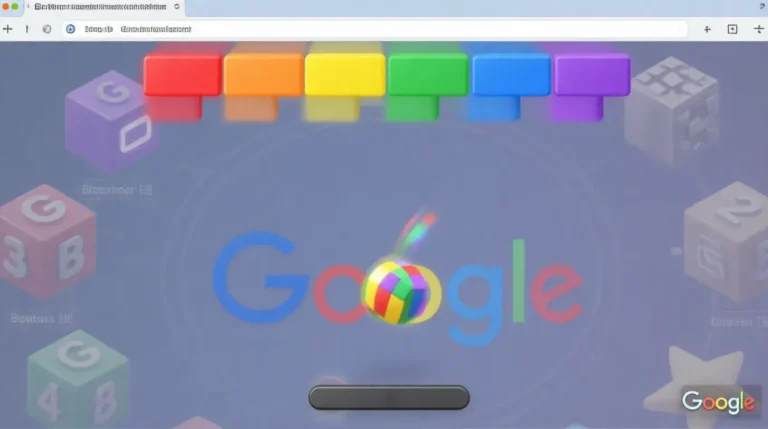
Google made a Doodle for him. And unlike most Doodles, this one doesn’t just honor the man — it lets you do exactly what he spent his life doing. Build a video game.
The game is right above this text. Play it first if you want. But if you want to understand who Jerry Lawson actually was and why this Doodle exists — the story is worth reading. It’s genuinely one of the most overlooked stories in the history of technology.
What is the Jerry Lawson Google Doodle Game?
On December 1, 2020 — what would have been Jerry Lawson’s 82nd birthday — Google released one of the most creative Doodles it’s ever made. The google doodle jerry lawson game doesn’t just celebrate his life. It puts you inside it.
You become a video game developer. You get a blank canvas, a simple set of tools, and total creative freedom. Build your own platformer — platforms, enemies, keys, doors, health kits, traps — then launch it and actually play through what you’ve made. It’s a game about making games. Which is exactly what Jerry Lawson’s entire career was about.
Why Google Made This Doodle
Google’s Doodle team has a habit of shining a light on people who shaped the world quietly — contributors who never got the fame their work deserved. Jerry Lawson is one of the clearest examples of that in the history of technology. A Black engineer in 1970s Silicon Valley who built the foundation of the entire video game industry, and who most people had never heard of until this Doodle put his name in front of millions.
What Makes This Doodle Different
Most Google Doodles are clever but passive — click here, watch something happen, move on. The Jerry Lawson Doodle asks something more of you. It asks you to create. That’s not an accident. The team designed it specifically so that every person who plays it spends a few minutes in the same seat Lawson sat in his whole career: building something from nothing and then watching it come to life.
Who is Jerry Lawson? — The Full Story
Gerald Anderson Lawson — Jerry to everyone who knew him — was one of the most consequential engineers in the history of video games. He didn’t start a famous company. He didn’t become a public figure. But the technology he built in the 1970s became the skeleton that the entire console gaming industry grew around. In 2026, with gaming worth over $200 billion globally, that’s not a small thing to say about someone most people still can’t name.
Early Life — A Kid Who Fixed TVs
Gerald Jerry Lawson was born on December 1, 1940, in Brooklyn, New York. Electronics weren’t a school subject for him — they were just how his mind worked. As a teenager he was building his own radios and fixing neighbors’ televisions for money. Not following instructions. Actually understanding what was broken, why it was broken, and how to make it work again.
That kind of mind doesn’t stay in Brooklyn. It goes looking for harder problems.
Moving to Silicon Valley
In the late 1960s, Lawson made his way to the San Francisco Bay Area, right as it was becoming the center of the technological world. He joined Fairchild Semiconductor — one of the companies that had already helped bring the modern transistor and integrated circuit into existence.
He was one of almost no Black engineers in Silicon Valley at the time. He navigated that by being, simply, excellent. He was also a member of the Homebrew Computer Club — the famous gathering of engineers and enthusiasts where Steve Wozniak once showed off an early prototype of what became the Apple I. Jerry Lawson was in that room. That tells you something about where he stood in the world of technology at the time.
The Fairchild Channel F — Changing Gaming Forever
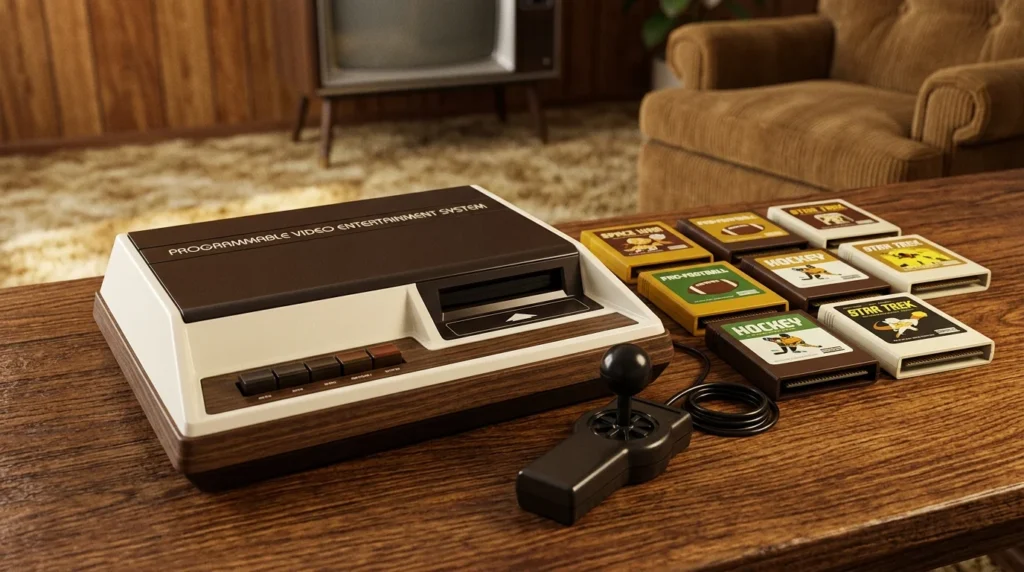
By the mid-1970s, home video games existed — but they were limited in a way that seems almost absurd now. The Atari Pong console played Pong. That was it. If you wanted to play something else, you needed a different machine. Nobody had figured out how to make one console play many different games.
Lawson figured it out. As chief hardware engineer at Fairchild, he led the team that created the Fairchild Channel F in 1976 — the first home video game console in history with interchangeable game cartridges.
That sentence might sound simple. It wasn’t. The idea that you could separate the game from the console — that a piece of software in a cartridge could slot into a machine and run — had never been done before. Lawson and his team invented the concept from the ground up. And every console that came after — the Atari 2600, the NES, the Sega Genesis, the PlayStation, the Xbox, everything — is built on that concept.
The Channel F also introduced an 8-way joystick, a pause function, and a microprocessor-based design that made the whole thing possible. Things that seem obvious today because Lawson made them obvious.
What Did Jerry Lawson Invent?
Since this is one of the most searched questions about him, here’s the direct answer.
Jerry Lawson invented the interchangeable video game cartridge. Before him, consoles played one thing and one thing only — whatever was hardwired into them. Lawson built the system where the console is a platform and the game is a separate, swappable cartridge. He also introduced:
- The Fairchild Channel F — the first cartridge-based home console (1976)
- The 8-way joystick that became the standard in gaming
- The pause function for home video games
- One of the earliest consumer products built around a microprocessor
He’s officially called the “Father of the Video Game Cartridge.” That title is accurate but undersells it. He’s really the father of the idea that a game console can be a platform — something that runs many different games rather than just one.
Video Soft and Later Life
After Fairchild, Lawson founded Video Soft, his own company developing games and tools for the Atari 2600. He kept engineering, kept teaching, kept mentoring younger engineers who crossed his path. People who knew him describe a man who genuinely loved sharing what he knew — not guarding it, not using it for status, just passing it on.
In 2011, the Game Developers Conference honored him with a special tribute recognizing his lifetime contribution to gaming. It was one of the first times the mainstream games industry had formally said what his work actually meant. Lawson passed away just weeks later, on April 9, 2011, at 70 years old.
Jerry Lawson’s Legacy in 2026
Fifty years after the Fairchild Channel F, the idea it introduced runs through everything in gaming. Consoles, phones, PCs, cloud streaming — all of them are built on the premise that software and hardware are separate things. That a device can run many different programs. That you don’t need a new machine for every new experience.
In 2026, Lawson’s name is finally starting to appear in school curricula, gaming history books, and technology courses. Google’s Doodle played a real part in that. Millions of people who had never heard of him looked him up after playing that game. The recognition is late — but it’s real.
How to Play the Jerry Lawson Doodle Game — Complete Guide
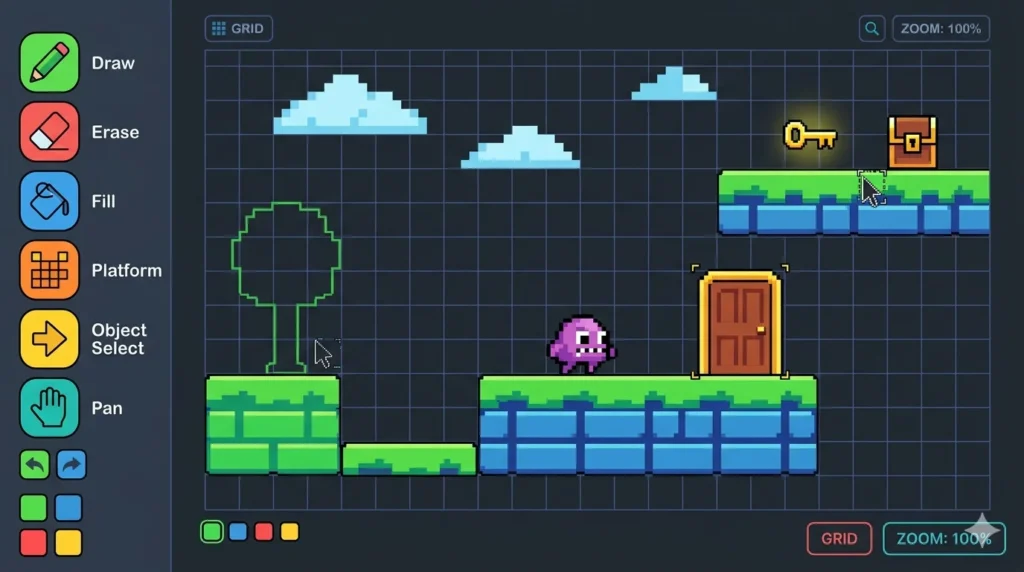
A lot of people open this game, stare at the Creator Mode interface for ten seconds, and close it thinking it’s too complicated. It’s not. It just needs about two minutes of explanation — which the game itself doesn’t really give you.
Game Modes Explained
There are two modes and they work together as a loop.
Creator Mode is where you build your level. You have a grid and a toolbar. Place platforms, enemies, keys, doors, health kits, and traps. Arrange them however you want. Your level, your rules.
Play Mode is where you test it. Once your level is built, launch it and play through it as a character. Find out if it’s too easy, too hard, or completely broken — then go back to Creator Mode and fix it.
You can also skip building entirely and load one of the pre-built levels that come with the Doodle, which is a good way to see what the game feels like before you start designing.
Creator Mode — Build Your Own Game
When you’re in Creator Mode, the toolbar on the left has everything you need. Here’s what each element actually does:
Platforms are surfaces your character stands and jumps on. They’re the bones of your level — use them to create floors, raised paths, gaps, and any structure you want players to navigate.
Enemies are moving hazards that hurt your character on contact. Where you place them matters more than how many you place. An enemy at the edge of a jump is much more dangerous than three enemies standing in an open area.
Keys and Doors are the core objective of every level. The player must reach the key first — only then will the door open. Separate them across your level to create a journey, not just a shortcut.
Health Kits give the player’s health back when picked up. Sprinkle them generously if your level is punishing, or leave them out entirely if you want something brutal.
Traps are instant hazards — spikes, pits, anything that kills immediately. Use them to punish specific mistakes and create tension at critical moments.
When you’re done building, hit the Play button and see what you’ve made.
Play Mode — Test Your Creation
In Play Mode you control a character through your level. Move, jump, collect the key, open the door, reach the exit without dying. Simple goal. Getting there depends entirely on what you built.
If something is wrong — a platform is in the wrong place, an enemy makes a section impossible, the key is unreachable — you’ll know immediately. Jump back to Creator Mode, fix it, test again. This is the actual process of game development, just compressed into a few minutes.
Using Existing Games
The Doodle comes with a handful of pre-built platformer levels. You can play them as-is, or open them in Creator Mode and change whatever you want — add enemies, move platforms, make it harder or easier. If the blank canvas feels overwhelming, starting with an existing level is a completely valid approach.
Jerry Lawson Game Controls
The game doesn’t explain the controls well, so here they are.
Movement Controls
| Action | Key |
|---|---|
| Move left | Left Arrow or A |
| Move right | Right Arrow or D |
| Jump | Spacebar |
Creator Mode Controls
| Action | How |
|---|---|
| Select a tool | Click it in the left toolbar |
| Place an element | Click on the grid |
| Remove an element | Right-click on it |
| Open / Close Creator | Press Enter |
| Switch to Play Mode | Click the Play button |
Play Mode Controls
| Action | How |
|---|---|
| Move character | Arrow keys or A / D |
| Jump | Spacebar |
| Return to Creator | Click the Edit button |
Tips for Building the Best Game in Creator Mode
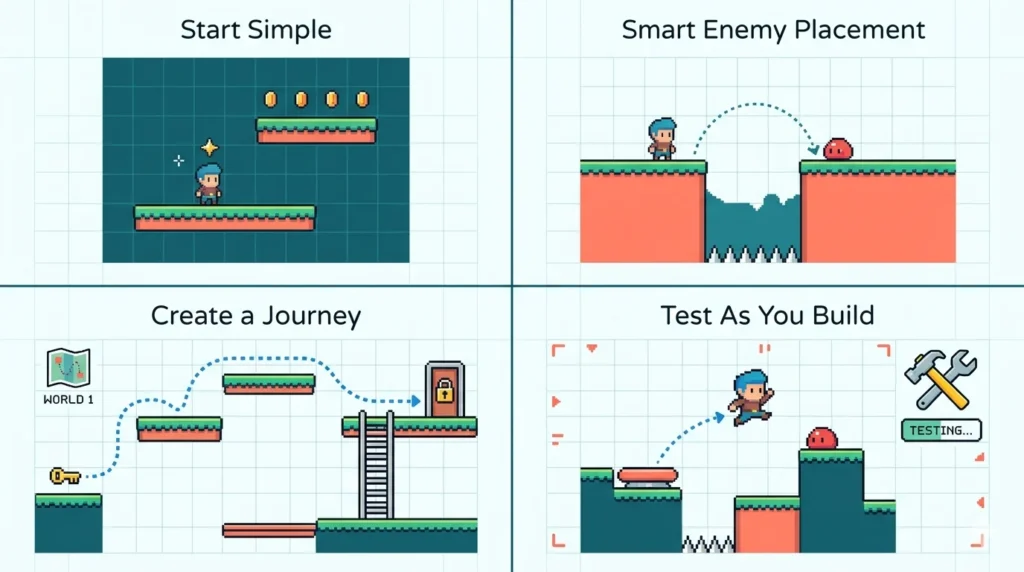
Building a level that’s actually fun to play is harder than it looks. Here’s what separates something satisfying from something that makes people close the tab.
Start Simple
The urge when you open Creator Mode is to build something big. Resist it. Start with one short path, a couple of platforms, one enemy, a key, a door. Get that working and feeling good before you add anything. A small level that plays well is infinitely better than a large level that’s broken.
Place Enemies Smartly
Enemies dropped randomly around your level are just annoying. Enemies placed at specific pressure points — right before a tricky jump, just after collecting the key, at the entrance to the door — create real tension. Think about where the player will be focused, and put the enemy where they won’t see it coming.
Use Keys and Doors to Create a Journey
If the key is right next to the door, your level has no point. Place the key somewhere that requires actual effort to reach — a high platform, a room full of enemies, across a series of gaps. Then put the door somewhere completely different. The path between them is your level. Make it count.
Test As You Build
Every few additions, switch to Play Mode and try what you have. Don’t wait until the whole level is finished to discover that a platform is positioned wrong, or that an enemy makes something literally impossible. Test early and often. It’s what real developers do — and it’s what this Doodle is quietly teaching you.
Jerry Lawson vs Modern Gaming — The Connection in 2026
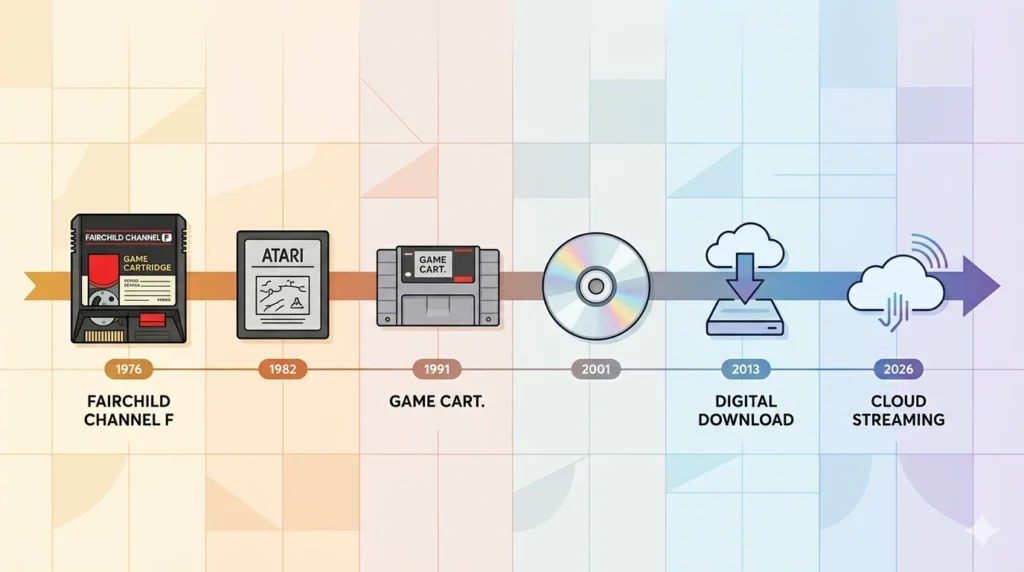
In 2026, gaming looks nothing like 1976. Photorealistic graphics. Online multiplayer with millions of players. Games running on phones, consoles, cloud servers, VR headsets. The distance between a Fairchild Channel F cartridge and a modern triple-A game seems almost incomprehensible.
But pull back the surface and the core idea is the same one Lawson proved: the game doesn’t have to be built into the machine. Software and hardware are separate. A device can run many different programs loaded from an external source. That’s the concept that makes every modern gaming platform work — consoles, PCs, phones, and streaming services alike.
When you download a game from the PlayStation Store, you’re using a digital version of the same idea Lawson made physical with a plastic cartridge in 1976. When a developer pushes a patch or an update, they’re operating in a world that assumes software independence — which is exactly what the Channel F demonstrated was possible.
The trillion-dollar gaming industry of 2026 is, at its foundation, an expansion of something one engineer from Brooklyn figured out fifty years ago.
Frequently Asked Questions
Who is Jerry Lawson?
Gerald “Jerry” Lawson was a Black engineer born in Brooklyn in 1940 who invented the interchangeable video game cartridge. He led the creation of the Fairchild Channel F — the first cartridge-based home console — and is known as the “Father of the Video Game Cartridge.” He passed away in 2011.
What did Jerry Lawson invent?
The interchangeable video game cartridge — the idea that a game could be a separate, swappable cartridge rather than hardwired into a console. He also led the development of the Fairchild Channel F (1976), introduced the 8-way joystick, and brought the pause function to home gaming.
When was the Jerry Lawson Google Doodle released?
December 1, 2020 — Jerry Lawson’s 82nd birthday.
Is the game free to play?
Yes. The google games jerry lawson experience is completely free — no download, no account, no payment needed. Just open the page and start playing.
Can I play on mobile?
Yes. The game works on mobile browsers. The creator tools are easier with a mouse on desktop, but everything works on phones and tablets too.
How many pre-built levels are there?
The Doodle comes with a small selection of pre-built platformer levels you can play immediately or modify in Creator Mode.
What is Gerald Jerry Lawson’s full name?
Gerald Anderson Lawson. He went by Jerry his whole life.
When did Jerry Lawson die?
April 9, 2011. He was 70 years old, and had been honored at the Game Developers Conference just weeks before he passed.
Why does Jerry Lawson matter in 2026?
Because the concept he invented — that software and hardware are separate, interchangeable things — is the foundation of every gaming platform that exists today. His name is finally starting to appear in schools, history books, and tech courses. The recognition is late but it’s real, and growing.
Final Word
Jerry Lawson built something that billions of people have used without ever knowing his name. The game cartridge. The swappable console. The idea that a gaming device is a platform, not just a product. He built all of it. In 1970s Silicon Valley. As one of almost no Black engineers in the industry. With almost no recognition for decades afterward.
Google’s Doodle didn’t just honor that. It let you experience it — sit down, build a game, make something work, feel for a moment what he felt doing this for real.
Play it. Build something worth playing. And remember: Gerald Anderson Lawson. 🕹️